


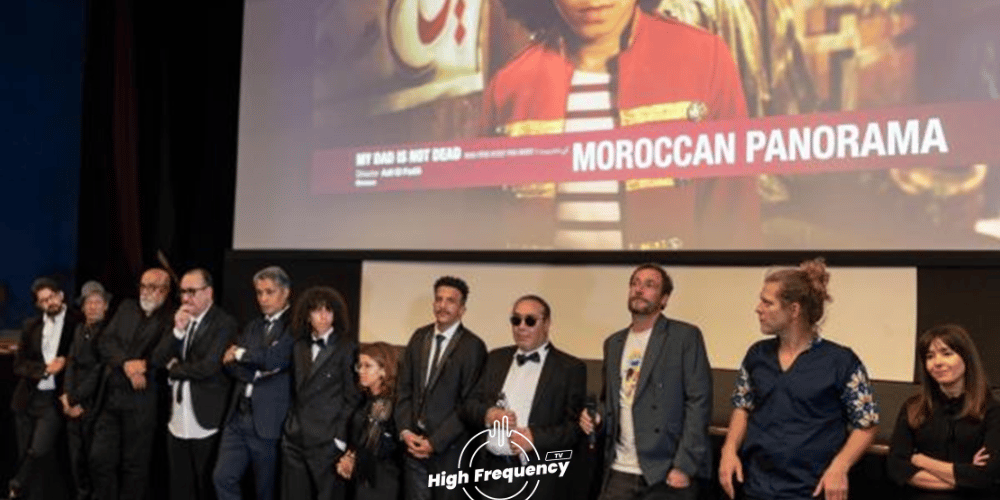
Moroccan director Adel Fadili has won the “Best Director” award for his film “My Father is Not Dead” at the 24th edition of the Rotterdam Arab Film Festival in the Netherlands. The protagonist of this film, the young Adam Régal, received a “special mention” from the jury for his impressive acting performance in the film.
Regarding the context of this festival, 33 Arab films participated in this year’s competition, which concluded its activities last night. Among these films were five Moroccan films, including “Mol El Telephone” by director Hamza Aitafii and “Qaninat” by Yassine El Idrissi. Additionally, two films were shown out of competition: “Animalia” by director Sofia Alaoui and “The Empty Third” by Faouzi Bensaïdi.
In this context, film critic Fouad Zueirik responded to the events in Fadili’s film by posting a long post on his Facebook account. He wrote: “Unfortunately, I have never seen this film before, and this is the first time I have had the chance to watch it.” He added: “The film took me on a pleasant cinematographic journey. I did not feel alienated in this film, but felt connected to various Moroccan details and memories.”
Zueirik continued: “The film is a nostalgic journey colored with political shades from the seventies and eighties, with beautiful visual paintings drawn with light and shadow. The effort in set design and cinematography, which is rarely seen in our Moroccan films, gave this film its visual splendor.” He also praised the film’s music, which he described as “vibrant” and meaningful, which enlivened the creative spirit of the film and enhanced the artistic joy in each scene.
He emphasized that the merit for the film’s music lies with the creative musician Abdel Fattah Naddi, who made his musical phrases a major pillar on which the film strongly leaned. He added that the music constitutes a large part of the film’s value. He also noted that the film does not tell a story in a classic way, but rather offers a series of scattered scenes that evoke memories and touch on political, popular, religious, and cultural themes.
Zueirik noted that this information: “you as a viewer must put together and connect within your own imagination.” He continued: “In this film, you are in a folk circus from start to finish, literally or figuratively, with its bustle, shows, people, absurdity, and surrealism… You find yourself in a society that possesses all these characteristics and acts as a circus with social, political, and security performances… Absurdity in fragments.”
The Moroccan critic emphasized that director Adel Fadili was aware of the concept he wanted to present and convey to the viewer. He tried to create an integrated work, some elements of which fell apart, but it remains a creative, respectable, and exceptional Moroccan film that offers a combination of beautiful images, music, and acting. Actor Abdel Nabi Al-Benyioui was powerfully present, and this work is an important addition to his acting career.”
He continued: “Also, the great Fatima Atif continues to excel in every work she participates in, as well as Nadia Kounda. As for the young Adam Régal, he was the witness and the link between us as an audience and the events of the film. This is my first impression of the work until I come back to it in a more detailed article. This film will certainly be an important addition to the Moroccan filmography.”
It is worth noting that the jury for the feature films at the Rotterdam Arab Film Festival consisted of Egyptian actress Bushra, Saudi actress Shaimaa Tayyib, and Dutch-Moroccan actor El Mahjoub Ben Moussa. The jury for the short films consisted of Lebanese director Diana Halabi, Dutch-Moroccan actress Fatima Khennfour, and Egyptian director Mohamed Ghazala.
AKHBARONA

Add comment