


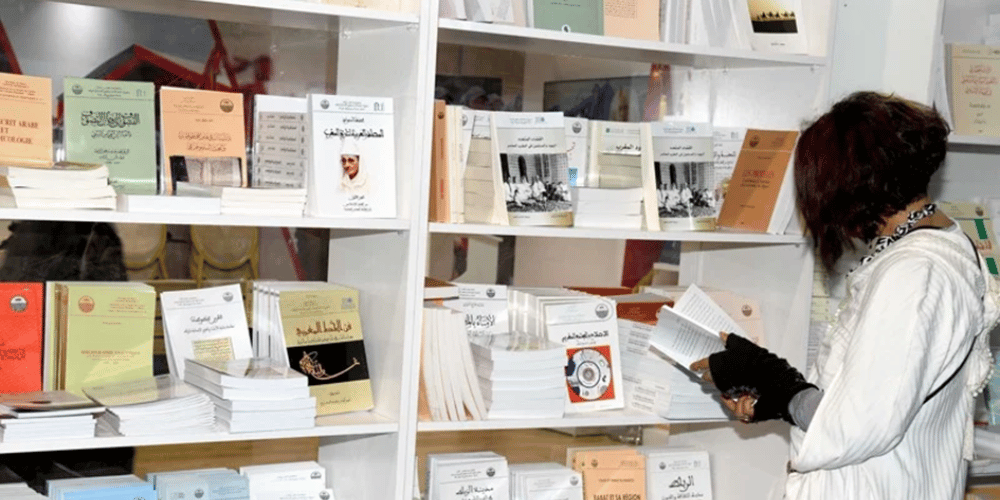
English-language publications accounted for just over 2.5 percent of the country’s total literary output in 2023, according to a recent report on publishing and books in Morocco.
The report, issued by the King Abdul-Aziz Al Saoud Foundation in Casablanca, covers the state of publishing and writing in Morocco in the fields of literature, humanities, and social sciences from 2022 to 2023, during which 3482 titles were published. On average, 1714 publications were released annually in both print and digital formats. The report also notes that Moroccan journals featured 496 contributions, 93 of which were digital.
Printed publications represented 92 percent of Morocco’s publishing output in the aforementioned fields. Digital publications, on the other hand, made up 8 percent, mainly published by public institutions, official agencies, and public research organizations.
The report highlights the challenges faced by private professional publishers in making a significant leap to digital publishing due to the fragility of the country’s economic model, Moroccan reading habits that view digital texts as free, and a lack of awareness about intellectual property and copyrights, explaining the decline in the number of digitized materials.
Regarding publication languages, the report estimates that Moroccan publications in the fields of literary creativity, humanities, and social sciences written in Arabic make up more than 78 percent of total publications, while those in French account for more than 17 percent, and English-language publications just over 2.5 percent. Publications in the Amazigh language did not exceed 1.51 percent.
The same institution counted 53 printed publications in Amazigh during the reporting period, with an annual average of 27 publications and no more than 1 percent of total Moroccan publications. The Rabat-Salé-Kénitra region dominated Amazigh publishing, as most publications came from the Royal Institute of Amazigh Culture in the capital Rabat, followed by the Souss-Massa region through the association “Tirra,” which issued 14 publications out of the 15 Amazigh publications in that region, while the Oriental region came in third in this regard.
The report also highlights the dominance of literary creativity in Amazigh publishing, with 43 creative texts, noting that despite the official adoption of the Tifinagh script since 2003, there are still issues at the level of standardizing the script used in Amazigh writing.
It added that the use of the Latin alphabet persists in published Amazigh texts, with 39 publications using a uniform Latin script and 19 using a dual script, while only 7 titles were published in Tifinagh script.
On another level, the report outlines that 191 titles were digitally published in Morocco in the fields of humanities and social sciences, dominated by the French language with 84 titles, followed by Arabic with 63 titles, and then English. It also highlights a strong presence of economic studies within the digital publishing output, accounting for 38.74 percent, followed by political and strategic studies and community studies with 23.03 and 10.47 percent respectively.
Furthermore, the foundation notes the ongoing trend of Arabization in the Moroccan publishing sector, as observed in reports since 2015.
It is noteworthy that French publications have declined compared to the 1960s and 1970s, which marked a unique phase in the history of Moroccan intellectual production, due to the Arabization movement that has influenced the teaching of humanities and social sciences in Moroccan universities since the 1970s.
Thus, the recently graduated generations of Arabic-speaking researchers and authors impact the fields of authorship and publishing.
Hespress English

Add comment